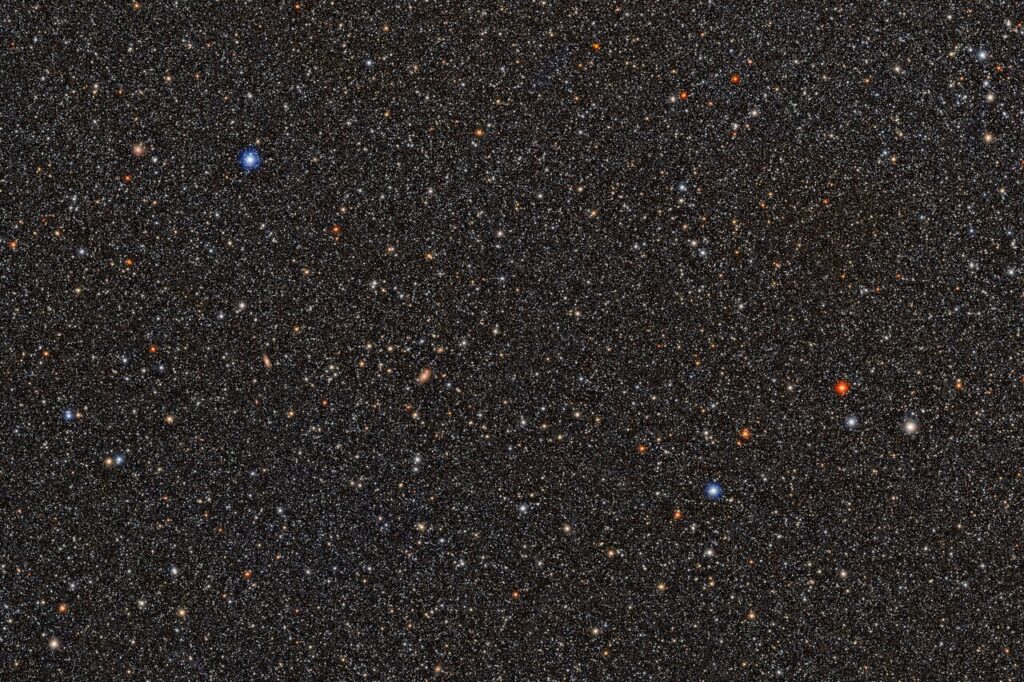
A world that could be 930 miles across was already in astronomers’ photographs a decade ago. It took a telescope in Chile and a search for a moving speck among millions of stars to recognise it. The object, provisionally named 2026 ED138, is the Vera C. Rubin Observatory’s first dwarf planet candidate.
The stars supplied the camouflage
Look along the flat disc of the Milky Way and our line of sight passes through some of the most densely packed star fields in the sky. By chance, that is the backdrop against which we see ED138. Those stars are far beyond it. The difficulty comes from how close their points of light appear together in a photograph.
ED138 is roughly 46 times as far from the Sun as Earth is. Even a sizeable object at that distance shows up as a speck of reflected sunlight. Pick one speck in a single exposure and there is little to tell you whether it belongs to our Solar System. Come back on another night and a clue emerges. The distant stars keep much the same pattern while ED138 shifts against them.
One moving dot turned up in a decade of images
On 13 October, Matthew Holman of the Center for Astrophysics | Harvard & Smithsonian ran Rubin observations through software he developed with colleague Kevin Napier. It looked for detections that could be successive sightings of the same moving body. Once Holman spotted ED138, astronomer Mario Jurić found 20 more observations in Rubin’s records.
Altogether, Rubin caught the object 30 times on 20 nights between March and July. Knowing where to look also unlocked an older archive. Images from the Dark Energy Camera in Chile placed ED138 in the sky as far back as 2016.
Its brightness leaves room for two very different sizes
The estimated diameter spans 600 to 1,500 kilometres (370 to 930 miles). A smaller body with a bright surface can return as much sunlight as a larger, darker one. Infrared observations could narrow that range. One requirement for dwarf planet status is that gravity has pulled the body into a nearly round shape. For now, ED138 remains a candidate.
Hungarian astronomers also take part in Rubin’s wider sky survey. In September, Budapest hosted its European conference, where early-career researchers worked directly with the survey’s new data.
Sources and image credit
Rubin Observatory discovery announcement · HUN-REN interview with Róbert Szabó
2026 ED138 orbital arc (without annotations). NSF–DOE Vera C. Rubin Observatory/NOIRLab/SLAC/AURA. Image processing by M. Jurić (UW), D. de Martin and M. Zamani (NSF NOIRLab). CC BY 4.0.
More space coverage from The Headline Room
How the Swift space telescope spent two decades catching fleeting cosmic events
SpaceX launches the final pair of solar arrays for the International Space Station